
(4) Programs that still exist
Further proof of deeper roots: 1912-1950s

Hello! Thank you for joining me in the next part of Treating Struggling Teens.
‘Programs that still exist’ is another long section, so I decided to break this one up. In this first half, you will learn about the Devereux Foundation and the O School— two programs that are still around today.
Without further ado, we continue.
PROGRAMS THAT STILL EXIST: 1912-1950s
One of the most prevalent programs that still functions is the Devereux Foundation, created by Helen Devereux in 1912. Today, Devereux schools are condemned on the Unsilenced website, a nonprofit that uncovers allegations of abuse in programs around the country (“Troubled Teen Industry Timeline.”). Yet for many other mental health organizations, including a 2002 encyclopedia on special education terms, Helen Devereux is “considered a pioneer in the field of education, operating on the premise that every student can learn and grow in an environment tailored to his or her needs” (Reynold et. al 310).
According to the Devereux Foundation’s website, Helen began teaching special needs children in her own home, because her students weren’t getting the education they needed at public schools. In 1918, she paid $94 to rent a house in Devon, PA, for her 12 students, and a year later she bought the home. The school prospered, and over the decades she opened more sites across the country.
Devereux Schools officially became a nonprofit in 1938. The Devereux Foundation as of 2023 has programs in thirteen states including Florida, Arizona, and California. It now treats and houses a variety of disorders, including autism and what they call “specialty mental health.” Its programs range from therapeutic boarding schools to residential treatment centers.
However, it is one of the organizations that has fallen under scrutiny in recent years for abuse. In January of 2023, a news service for lawyers wrote that “a federal judge denied... [Devereux’s] bid to dismiss a case brought by children who claim they were abused at facilities in several states.” Despite multiple abuse allegations, Devereux continues to take in students and does not appear to be shutting down any time soon.
The still functioning Sonia Shankman Orthogenic School in Chicago, Illinois (later renamed the O School) opened soon after the Devereux Foundation. Now considered a residential treatment center, it was created by Dr. Josephine Young in 1915 as an offshoot of a clinic for children with a “doubtful mentality,” according to an admissions packet, as well as a way for student clinicians to learn how to treat such populations. Similarly to Helen Devereux, Dr. Young borrowed money to purchase an apartment to open a day school for her patients, and it soon became self-sufficient. By 1934, it had shifted from treating “cognitively impaired children, to a [mostly residential] program designed for the study and treatment of children with adjustment difficulties resulting from educational, emotional, social, and personality disturbances” (“Sonia Shankman”).
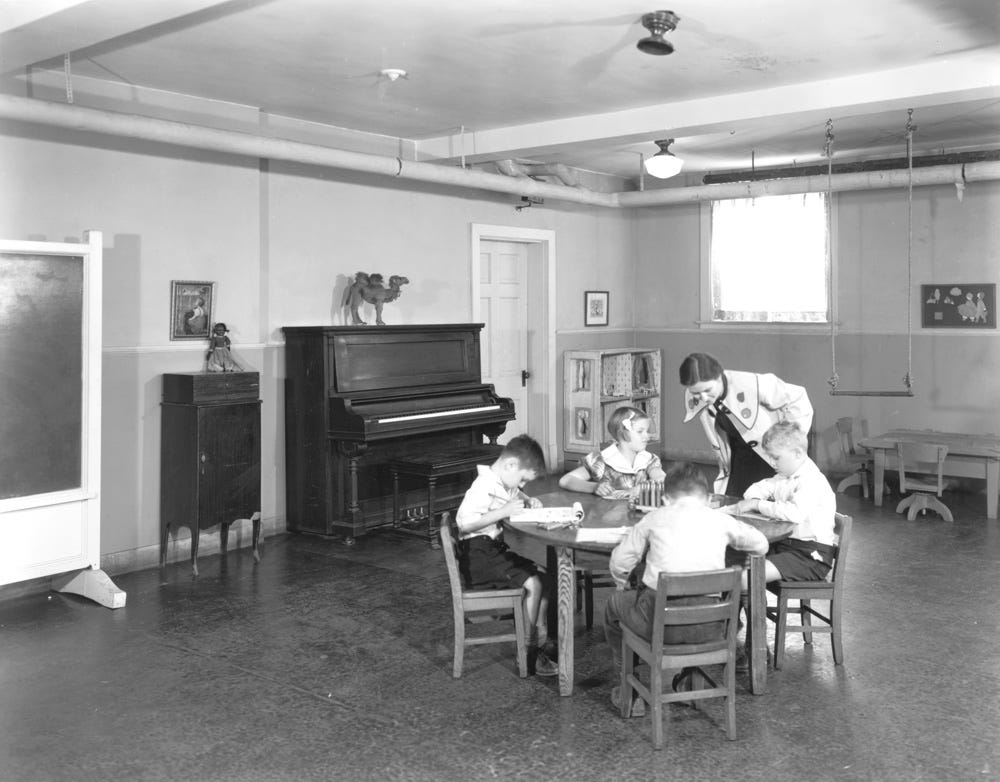
The school’s reputation grew when the controversial Dr. Bettelheim took over as the fifth principal in the 1940s. For many decades he was deeply respected for his work on the causes of autism. According to a summary of his biography, he believed that autism and other disorders were the result of “toxic familial environments that denied the basic emotional needs of babies unlucky enough to be born into them” and as a result, “patients were rarely permitted to visit their families” (Leeman). The O School was also renowned for its progressive milieu, also as a result of Bettelheim, which included their belief that the “intrapsychic anxieties of troubled youths need not be contained” (Reynold et. al 692) and that surroundings affected a person’s behavior.
Next time, I cover the controversies surrounding the O School and Dr. Bettelheim in particular.
In other news, large parts of the U.S. are currently experiencing very cold temperatures. If you, like me, are in one of those areas, I hope you’re staying warm! My dog is a big fan of the snow so she’s having the time of her life. Me, not so much.
See you next week for the second half of
PROGRAMS THAT STILL EXIST: 1912-1950s
—Julia